
Anadicapu, the tiny village where I stay, lies in the Wayanad district of Kerala. Not many know the interesting story of how the name Anadicapu was linked to the British!
Like many places in India that have anglicised names, Wayanad was previously called Vayalnadu. Translated from Malayalam, it means “land of paddy fields.”
Just doesn’t add up, does it? Paddy fields in the hilly regions of Wayanad!
But before the British started tea cultivation in Vayalnadu (around 1890), destroying thousands of hectares of forest in the process, almost every family in Vayalnadu used to cultivate rice for their own use. Their staple diet was the simple “kanji” — rice boiled in excess water and eaten with a little pickle or chamandi (coconut chutney).
Water was abundant in Vayalnadu, and wherever possible, land was flattened and rice was grown there.
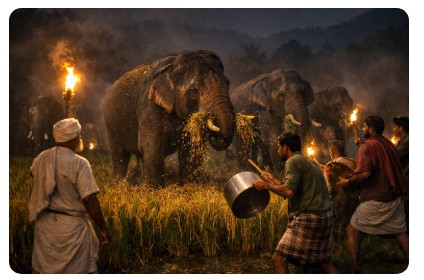
Harvesting rice has to be done at the right time, when the stalk is mature. A little early or late results in loss of weight or reduced quality. Unfortunately, while the farmer patiently waited for the right time to harvest, elephant herds would visit after nightfall and camp in the paddy fields. First, they would yank the stalks from the slushy fields and then beat them against their massive bodies to remove the wet mud stuck to the paddy, before eating the grain along with the stalk.
The continuous sound of elephants beating paddy would echo through the night. Men from the village would light fires and beat vessels and drums to try to scare away the elephants. It was a futile task, and ultimately the cacophony would last all night long!
All this noise was not very much fancied by the Brits who had settled in this part of Vayalnadu, looking for peace and quiet, even naming their tea estate after their peaceful and noble administrator, the Viceroy of India, Lord Ripon.
Soon enough, they realised that living here was not exactly soothing to their already highly strung nerves. Out of irritation and resentment at the noise, they called this place the “Elephant Beating Camp,” because the sound of elephants beating wet paddy, together with the clanging of vessels and the thumping of drums, would echo far across the valleys and tea estates, resonating within the walls of their big bungalows.
One can well imagine the white officer-gentleman in the bungalow trying to console his lady, who was probably ruing the day she turned down the vicar’s son to marry a man in uniform: “Alas, my dear, the elephants are a-visiting again. I’m afraid you shan’t get a wink of sleep tonight!”
Local Malayalis liked the English name but found it too long. This resulted in adapting and shortening it to:
“Anadicapu” — Ana (elephant), adi (beating), capu (camp).
However, over the last three decades, the practice of locals growing their own food has given way to store-bought grains and groceries. Paddy fields have been replaced by resorts and homestays, while elephants stay in the forests, not caring to cross paths with tourists.
Happily for them and us, the English folk are long gone, leaving behind their legacy — the beautiful Ripon tea estate, and of course, the evocative name, Anadicapu.
Philip Peter
 A Hundred Contemplations
11 responses to “The Elephant Beating Camp!”
A powerful piece of storytelling, Philip!
Very interesting!
Thanks Jean!
A tall story indeed! Growing paddy in hilly grounds ! Need some salt to swallow this story!😊
Strange but true Conrad!
Yes of course! Truth is always stranger than fiction! Keep them stories coming Philip!😊
Had some salt and found the story very enlightening.Interesting information. Well written indeed
Thanks Sheila! The story of Anadicapu was told to me by an elderly land owner here, Silvichetta, who recently passed away. Bless his soul.
Very interesting history Philip, keep writing love your story telling.
Thank you Karen!
Well written and very interesting.Being a Malayali whose home town is Palakkad which is not very far off from Waynad this story is a first _time_hear for me .Thanks for the informative reading
Thank you Geetha!