
In our daily lives, we often find ourselves overwhelmed by stress, questioning our abilities, or feeling like something is missing.
What we may lack is resilience—the ability to persevere and adapt when faced with life’s challenges. From work deadlines to family responsibilities, life is filled with ups and downs.
So, how do we cultivate resilience?
We can learn from resilient individuals who face obstacles head-on, take purposeful steps, and believe in their ability to influence outcomes. Resilient people don’t let setbacks drag them down; they stay committed to solving problems and remain positive. On the other hand, those lacking resilience may avoid new experiences due to fear of failure.
The good news is resilience is a skill we can develop. By changing how we approach setbacks, we can better navigate life’s hurdles. After all, challenges are inevitable, but resilience equips us to overcome them with strength and determination.
Here are some signs that you might need to work on your resilience:
- You don’t feel many positive emotions.
- You keep making the same mistakes over and over again, like procrastinating or being too aggressive, even though you know they’re not working.
- You handle problems well but hesitate to step outside your comfort zone.
Once you become more resilient, you’ll be better equipped to handle life’s obstacles and still find time to learn new things and enjoy life. So, let’s get started.
What is Resilience?

In 1989, my husband passed away due to a medical condition when I was 36 years old with small children. A few days after his death, while I was sitting alone, contemplating the future, my 5-year-old son asked me, “Ma, when I see your face, why are you always crying?” I wasn’t shedding tears or sniffing and hadn’t realized that I appeared that way to him and others. At that moment, I made a decision—I needed to create a happy environment for my children. I need to keep us from wallowing in negative thoughts.
All sorts of scenarios of single moms had crowded my mind. Didn’t that one’s son become a drug addict? Didn’t that girl go wayward because she didn’t have a father figure at home?
Soon after settling down in Bangalore, I joined a club, and we would all go swimming and play badminton together. It was great fun! But my finances were low, and I needed to work. . I waited until my children grew a bit older before searching for a job. At the age of 42, I enrolled in a computer programming basic course, and landed my first job.
Transitioning from an active career as an Army Nurse to a housewife and landing in the IT industry was tough initially, but I persevered through those initial years and retired after 23 years in the IT industry.
Why be Resilient?
- To assess risk, prepare for potential problems, and plan for solutions
- To deepen your emotional awareness and your interpersonal skills
- To increase your ability to focus on the present
- To find meaning in your life
The Nature of Resilience
Here are some points that’ll help you understand Resilience and what goes into being Resilient:

1. Emotion Regulation: Emotion regulation means staying calm under pressure.
2. Impulse Control: In the 1970s, Dan Goleman, the author of Emotional Intelligence, conducted an interesting study. Young children, around seven years old, were brought into a small room where another researcher awaited. The researcher explained to each child that he had to leave for a few minutes but before he did, he wanted to offer the child a marshmallow. The child could eat the marshmallow now but if the child held off on eating it and waited until the researcher returned, he’d give the child a second one. Ten years later, Goleman tracked the children who had participated in the experiment; they were now high school seniors. Those children who could control their impulses, who could delay the gratification of one marshmallow to get two, were doing significantly better socially and academically.
So, it makes intuitive sense that emotion regulation and impulse control are closely related. If your impulse control is low, you will accept your first impulsive belief about the situation as true and act accordingly. Often, this produces negative consequences that can hamper your resilience.
3. Optimism: Optimism implies believing in our ability to handle the adversities that will inevitably arise in the future. And, of course, this reflects our sense of self-efficacy, our faith in our ability to solve our own problems and master our world, which is another important ability in resilience. Resilient people are optimistic, physically healthier, and have strong relationships.
4. Causal Analysis: Causal analysis refers to people’s ability to accurately identify the causes of their problems. The most resilient people have cognitive flexibility and don’t reflexively blame others for their mistakes. Nor do they waste their valuable reserves of resilience ruminating about events or circumstances outside their control.
5. Empathy: Your empathy score represents how well you’re able to read other people’s cues to their psychological and emotional states. Some of us are adept at interpreting the non-verbals of others – their facial expressions, their tone of voice, their body language—and determining what people are thinking and feeling.
6. Self-efficacy: is the belief that you can master your environment and solve problems as they arise. People high in self-efficacy stay committed to solving their problems and don’t give up when they find that their original solution doesn’t work. Optimism and self-efficacy go hand in hand.
7. Reaching out: Once you’re more resilient, an interest in reaching out and taking risks often emerges. Resilient individuals pursue new experiences, form relationships, and assess risks with sound judgment.
What Factors contribute to becoming Resilient?
- Self-awareness: enables you to track what’s going on internally with you.
- Self-regulation: helps change your thoughts, emotions, physiology, when those things are getting in your way.
- Positive institutions: the family institution, or the community, or your workplace, that either support and further grow your interpersonal and intrapersonal variables, or erode them over time.
- Mental agility skills: tells you when you’re getting bogged down by a rigid perspective, and how to have more flexibility.
It’s good to remember that:
- Life Change Is Possible
- Accurate Thinking Is the Key to Boosting Resilience
- Refocus on Human Strengths
Resilience matters, and it can be learned.
Studies have shown that resilience training significantly boosts performance. In one study, participants outperformed their peers on key performance metrics just three months after training. Salespeople and managers with lower resilience who learned the seven skills of resilience improved their performance by 50% to 100%.
Many people worry about their future prosperity and happiness. If you have a child with low self-esteem and want to boost their confidence, fun, and adventure, consider:
- Enhancing their capacity for resilience.
- Learning to understand your thinking styles and developing skills to circumvent them
- Utilizing the seven skills of resilience
- “Listening” to your thoughts, identifying what you say to yourself when faced with a challenge, and understanding how your thoughts affect your feelings and behavior.
Skills of Resilience—Know Yourself & Change Skills
Know yourself Skills

Change Skills
- Challenging Beliefs: Identify the true causes of a problem by challenging your beliefs and analyzing the beliefs about the causes of adversity.
- Putting it in Perspective: Keep the implications of problems in perspective.
- Calming and Focusing: work to impact negative emotions directly
- Real-time Resilience: enables you to fight back against your non-resilient beliefs in real-time.
1. Adversity—what Pushes Your Buttons?
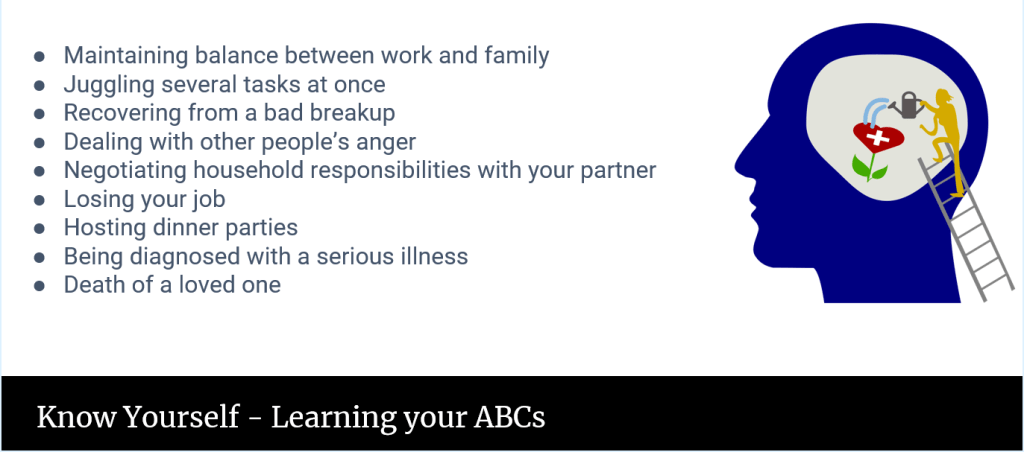
2. Beliefs—what are your stereotypical beliefs?
Your in-the-moment beliefs about adversity can drive your emotions and behaviors. When adversity strikes, do you:
- Tend to blame yourself or others?
- See the cause of the problem as permanent or fleeting?
- Believe the cause will undermine everything else in your life, or is it specific to the one adversity?
You need to train yourself to think about the causes and implications of adversity. Resilience requires a balance between thinking about the past and planning for the future.
You can think of ticker-tape beliefs as surface beliefs, because they float on the surface of your awareness. Even though you may not be aware of your ticker-tape beliefs in any given moment, you can shift your attention to them with relative ease and identify what it is that you’re saying to yourself.
3. Consequences Are Feelings and Behaviors
BELIEF and CONSEQUENCES
For each type of belief we label, we can predict which emotion and behavior will follow.
- Feeling like your rights got trampled on -> Boom, anger! Anger comes when we believe we have been treated unfairly, thwarted in the pursuit of a goal, even when we believe, however irrationally, that it is an inanimate object doing the transgressing:—“Silly car. It simply refuses to start up”—or circumstance—“It’s raining just for spite. Insults to our self-esteem cause us to feel harmed or that our rights have been violated
- Dealing with some major loss or feeling worthless -> That’s a one-way ticket to sadness or even depression.
- Stepping on someone else’s rights -> Cue the guilt trip. Guilt is a powerfully motivating emotion. One useful function of guilt is to get us to stop doing whatever it is that we are doing that is generating the guilt. Another is to motivate us to make amends.
- Seeing a storm on the horizon -> Hello there, anxiety and fear!
- Measuring yourself against others and not measuring up -> Ah, the good ol’ embarrassment.
Did you know that how you do at work, in your relationships, and even how you feel physically is pretty much a mix of your mood and what you do?
Detecting Thinking-trap Patterns in Yourself
Which of these traps do you identify with?
- Mind-reading: assuming you know what another person is thinking, or expecting others to know what you are thinking
- Me: thinking you are the sole cause of your setbacks and problems and you cause harm to others
- Them: blaming other people or circumstances as the sole cause of your setbacks and problems
- Catastrophizing: ruminating about the irrational worst-case outcomes of a situation
- Helplessness: feeling that negative events will impact all areas of your life and you have no control
An office scenario: You give a document for review, and the reviewer replies, ‘Can you share the previous version?’ You get a bit agitated and think, ‘This guy is out to get me. He wants to cross-check if I’ve included all his comments.’ A few days later, the reviewer replies, ‘I made an error in my earlier comment. Here is the right one. Can you fix it?’ You feel foolish for having assumed the wrong reason.
Here are Eight Common Thinking Traps

Mind Reading:
When I started working at my first software company, 80% of my colleagues were fresh out of college, and the remaining were all below 30 years old. Initially, I would fall into the mind-reading trap, imagining what they were saying or thinking about me, a 42-year-old housewife in an IT company. Fortunately, I didn’t stay too long in this trap!
I navigated potential conflicts arising from interactions with colleagues and bosses much younger than me by being supportive, friendly, and actively participating in all company-related social events and causes. At times, I even organized sporting events and worked diligently to achieve success in my work. Throughout this journey, several factors played a crucial role:
- Self-awareness
- Mental agility
- Positive interactions
- Connections
I refused to let the negative thoughts overpower me.
Detecting Iceberg Beliefs
An iceberg as we know is a large floating mass of ice detached from a glacier. The goal of Detecting Icebergs is to make you aware of the iceberg beliefs that are:
- Unwittingly causing you to overreact or react in a way that is different from what your ticker tape would predict
- Undermining your decision-making
- Causing you to over-experience a particular emotion
Everyone has deeply held beliefs about how people and the world should operate and who they are and want to be. We call these iceberg beliefs because they often “float” beneath the surface of our consciousness so we’re not even aware of them. Often these beliefs guide us to behave in ways that are true to our values. Sometimes, however, these deep beliefs interfere with our ability to live the kind of life we want, and they explain why we overreact to seemingly minor issues or have a hard time making what seem like simple decisions.
Iceberg beliefs tend to be general propositions or rules for living that apply to more than the situation at hand. “The world is a dangerous place,” “People must respect me at all times, are examples of iceberg beliefs.
The feelings and beliefs you carry about yourself, just like icebergs, can lurk beneath the surface—you may have never even spoken them out loud, but they impact your thinking, your confidence, and the way you move through your life.
Most of the “personality” clashes that occur at work are due to differences in iceberg beliefs, and these beliefs are also responsible for many of the rifts between couples. By using the skill of Detecting Icebergs, you will better understand your core values and motivations and those of the significant others in your life.
Questions to ask yourself:
- What is this belief costing me?
- How is it helping me?
- How can I change it so that I reduce the costs and increase the benefits?
- How would you describe yourself? Are you more” “achievement-oriented, acceptance-oriented, or control-oriented?
- When you find yourself shrinking from opportunities, is it out of a fear of failure, concerns over rejection, or worries about not being in control?
- When you have problems in your relationships, is it because you are so focused on your career that you don’t make enough time for your personal life, or are you too needy or overly controlling?
Detecting Icebergs
- This is an important step in increasing your emotion regulation, empathy, and reaching.
- It’s a skill that will significantly improve your relationships.
- Surface beliefs (float on the surface) vs Underlying beliefs
- Iceberg beliefs: Underlying beliefs are general rules about how the world ought to be and how you should operate within that world. Many people have iceberg beliefs that fall into one of three general categories or themes: achievement, acceptance, and control.
You use Detecting Icebergs to bring your underlying beliefs to the surface so that you can evaluate them and, in essence, determine what’s making you “tick.”
As you practice this skill, you’ll probably find that you have a core set of iceberg beliefs that affect your mood and behavior over and over again—across a variety of situations. Once you’ve identified what they are, it’s time to shift out of insight mode and start changing the beliefs that are getting in your way.
Here are Four Change Skills to Practice
- Challenging and analyzing your beliefs
- Putting it in Perspective.
- Calming and Focusing
- Real-time Resilience enables you to fight back against your non-resilient beliefs in real-time.
Challenging Catastrophic Thinking
When do you catastrophize? Some typical triggers are:
- Ambiguity
- Something you value highly is at stake
- You already fear the situation
- You are run down or depleted
Step 1: Write down your current thought process chain
Step 2: Estimate the probabilities of your worst-case fears
My catastrophic experience in February of 2022: I was fine when I went to bed but had a sort of disturbed sleep, and when I tried to get up in the morning, I just couldn’t. My head felt funny, and it was throbbing. I couldn’t stand, the room rotated around me and I flopped back on the bed. My head felt like there was a lot of water filling in. I developed severe painful cramps in my body. I thought to myself, ‘This is my end moment, let me close my eyes, fall into a stupor, and pass away. Why should I fight death?’ And closed my eyes.
A few minutes later, I said No to the thought of death, recited my scripture passages, somehow reached my phone on the table, called my daughter, and unlocked the door to my room even though I couldn’t stand. Help came soon enough, and I was okay after a week of hospitalization.
Never let these catastrophic thoughts overwhelm you; take action! Reciting scriptures calmed me and reduced my anxiety, allowing me to think better, and to reach out for help.
Putting it in Perspective
When you put things into perspective, you’re gaining a clearer understanding of what lies ahead after dealing with challenging circumstances.
If you’re the kind of person who tends to overthink or make mountains out of molehills, here’s your homework: jot down what’s been keeping you up at night. Once you’ve got a handle on what’s bugging you, you’re ready to dive into putting it in perspective.
This skill acts as an antidote to anxiety. It helps dial down worry to a manageable level, one that matches the actual threat, allowing you to prepare for what comes next after the storm hits.
Calming and Focusing
Calming and Focusing are powerful tools that help you quiet your emotions when they are out of control, focus your thoughts when they are intrusive, and reduce the amount of stress. The more you practice Calming and Focusing and increase your Real-time Resilience, the more resistant to stress you’ll become.
Real-time Resilience
Real-time Resilience, takes the essential ingredients of Challenging Beliefs and Putting It in Perspective and uses them to fight back against counterproductive beliefs as they occur. Challenge those counter-productive thoughts on the spot.
These two skills—calming and focusing, and real-time resilience—can stand alone but are often used together. At times, calming and focusing take the edge off intense emotions, allowing you to use real-time resilience to challenge negative thoughts.
These three problems—losing your calm, losing your head, and losing your focus—drain your reserves of resilience.
They cause you to waste valuable time in your professional life, they can deeply wound your relationships, and they even can make you physically sick. Consider the amount of stress you feel.
- So one strategy is evidence, that when you hear that really counterproductive thought, use data to prove to yourself why that thought is not true.
- Sentence starter: That’s not true because… or A better way to see this is…
- Reframe: using optimism strategically:
- Plan: when your counterproductive thought is in the catastrophic thinking, If X happens, I will Y Sentence starter: If X happens, I will Y

Example of my Real-time Resilience Response
Situation: Interviewed for the job at Symphony Services at the age of 52 years.
My Mind-Reading: They’ll probably think after seeing me, that she’s too old, she’ll not be able to learn quickly, will she be able to manage a new business unit?
I used the Evidence Strategy: hold on, that’s not true because what does their ad say, The company does not discriminate against age, sex, or religion; it’s a multinational company. My age will not be a criterion for them to judge.
Me Trap: I’m not smart enough, All the young people seem so accomplished and capable.
The reframe strategy: Maybe, but a helpful way to see this is that, yes I’m older but I have experience.
I’d like to end with a funny incident. Thinking is the Key
A few years back, there was a conference, and Oracle was one of the sponsors. Someone suggested, ‘Why not do a flash mob dance during the break time?’ I thought about it for a long time, eager to join but hesitated. Then, a day before the conference, I messaged the lead dancer, Shiny, and asked her, ‘Shiny, am I too old to join your flash mob?’ She replied, ‘No, Jean, that’s terrific! Come over, and I’ll show you the steps.’
So, I drove to her office in another location in Bangalore, and she showed me the dance and also recorded it, along with the cue on when I should come in. When I shared with my children, my daughter was horrified as she was attending the conference too. Nevertheless, I practiced the steps in my room in front of the dressing table mirror.
I learned the dance but knew that I was a fraction slower than Shiny. The next day, I took a piece of paper and sketched the steps symbolically from memory – like left arrow, right arrow, etc.
The flash mob dance started with a bang during the lunch break. I came in at the cue and danced with the rest. My daughter was right in front and recorded the dance. When I looked at the video, I was delighted to see that I was in sync with the main and other dancers.
I attribute this to preparing your mind. Try it and it will work wonders.
Thank you and I hope to hear some of your resilient stories.
Incidentally, I’m 70 years old, and it’s been 35 years since that first calamity struck.
I hadn’t read The Resilience Factor back then, but recently, as I read it, I found it resonated with me, as many of my personal experiences mirror those in the book.

Jean Rao
Gave the above talk on March 8, 2024 at Soliton Software, Coimbatore as part part of their Women’s Day Celebrations.
Reference: “The Resilience Factor” by Karen Reivich and Martin Seligman.
 A Hundred Contemplations
One response to “The Resilience Factor”
Very powerful and motivating Jean! Much to learn here!!