
A Journey of Survival and Change
Speed Bonnie Boat, Like a Bird on the Wing, Onward the sailors cry,
Carry the Lad that’s born to be King, Over the Sea to Skye.
Loud the winds cry, Loud the Waves roar, Thunderclaps rend the air, Baffled our foes stand by the shore, Follow they do not dare.
“The Skye Boat Song” is a late 19th-century Scottish song adaptation of a Gaelic song composed by William Ross 1782
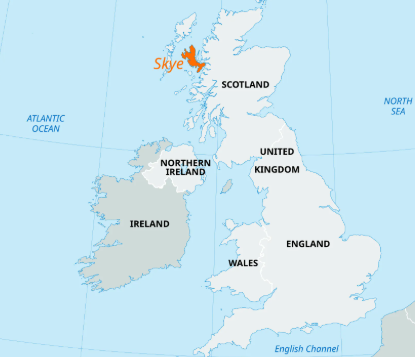
The Isle of Skye: A Wind-Torn Land
The Isle of Skye, a remote island in northwest Scotland, is known for its stormy weather and rugged landscapes. Its history is steeped in clan feuds, English oppression, and the tragic Highland Clearances. The islanders, primarily MacDonalds and MacLeods, endured centuries of hardship, battling both the elements and human conflicts. Bonnie Prince Charlie, hunted by the English, landed there in an attempt to regain the throne. However, he lost, and as the English pursued him, he was rowed to safety by a woman named Flora MacDonald, whose cottage we visited—now a museum.
Clan Rivalries and Historic Bloodshed
The two main clans on Skye were the MacDonalds and the MacLeods (pronounced “Macloud”). The island’s history is marked by centuries of bloodshed and feuds. When we lived there, some people still refused to speak to members of the opposing clan. The hatred for the English was rivaled only by the mutual hatred between the clans, with gruesome tales of children being thrown from castle towers.
The Highland Clearances
In addition to clan wars and battles against the English, the people of Skye suffered during the Highland Clearances of the 19th century. Wealthy landlords evicted crofters to seize land for lucrative sheep grazing. Thousands of people were driven at gunpoint to the seashore, many emigrating to America or Canada.
Skye and the World Wars
During World War I, many Skye men were drafted into the British army. A tale is told of a soldier granted a week’s leave from the trenches of Flanders. He traveled back to Scotland, reaching a point where he could see Skye, but with his leave running out, he had to turn back. He reportedly died in the trenches, telling a friend that he was content to have seen his home one last time.
The Misty Isle
Though Skye is battered by gales, hail, and stinging rain, it is known as the “Misty Isle.” Thick fogs descend suddenly, making it impossible to see one’s own feet.
Seeking an Alternative Life
By the late 1980s, Beryl and I, who were not then Christians, had removed our daughter Alice from school. Despite being qualified teachers, we had become disillusioned with British education and society. We had lived godless lives ourselves, growing up in Britain during the depravity of the 1960s, but as we moved forward with our daughter, we sensed that modern Britain was on a doomed path.
Seeking escape from the rat race, we discovered the self-sufficiency movement and searched for a place to grow our own food and raise animals. Limited finances narrowed our options to a few isolated locations where property was affordable. Eventually, we found a croft (a house with attached land under special laws) on Skye.
Early Struggles and Local Hostility
As English “incomers,” we faced local suspicion. The sellers of the croft took advantage of our inexperience, exploiting land rights and resources. Attempting to erect a fence for our daughter’s safety led to conflicts with neighbors. The legal system offered little help, forcing us to take matters into our own hands.
Adapting to Rural Life
Despite initial resistance from locals, we gradually earned respect. Our Jersey cow gave birth unexpectedly, initiating us into cattle care. Learning to milk was another struggle, as locals feigned ignorance. Winter brought further hardships—cows refused to leave the barn, requiring water to be hauled manually.
The Realities of Crofting
The 13 acres we purchased were classified as “severely disadvantaged agricultural land,” with such poor grass quality that two acres could support only one cow. Our first hay harvest was so sparse that locals informed us it was “hay-making time” when the grass was barely taller than that in an English garden.
We arrived expecting hardships but were still unprepared for the deceit of the croft’s former owners. They assured us of their honesty, which immediately raised suspicions. Sure enough, upon arrival, they manipulated the situation to their advantage, monopolizing the best part of the house, keeping a stall for their cow, and even using our toilet. We also discovered they had falsely claimed peat rights for the property.
Struggles with the Locals
English folk are not welcomed on Skye. We were “incomers,” seen as representatives of the English armies that had once massacred Highlanders. Winning acceptance was a slow process. When we asked Archie, the local shopkeeper, if anyone could teach us how to erect cattle fencing, he denied knowing anyone—despite being a professional fencer himself! Years later, we paid him to build our fences.
Adventures in Livestock
We had never handled a cow, yet our Jersey cow, Clover, was heavily pregnant. One day, Alice interrupted our conversation to point out that a tiny calf was standing beside Clover! With no experience, we sought help from a neighbor known for his dislike of Englishmen. Surprisingly, he was friendly and instructed me to pick up the calf and carry it to the byre. Expecting to be attacked by the mother’s horns, I cautiously complied.
Milking proved another challenge. The locals feigned ignorance, despite all of them owning cows. When I attempted to milk Clover, she kicked me. After several failed attempts, we allowed the calf to drink all the milk.
Sheep were equally challenging. During lambing season, a struggling ewe prompted a call to the vet. His advice? “Just stick your hands up her and pull!” We learned the hard way that lambing burns the arms raw.
Raising sheep was financially unsustainable. The cost of shearing, vitamins, and feed far exceeded the profit from selling lambs. Even dipping sheep in chemicals proved troublesome—our sheep, unfamiliar with dogs, refused to be herded, leaving the herding dog sulking in defeat.
Encounters with the Vet
Our vet was a jovial yet blunt Irishman. When our cow was “bulling” (showing heat after a failed pregnancy), he performed artificial insemination. We mentioned our calf’s limp, and he scoffed, “Wouldn’t you limp if your mother jumped on you? She’ll be fine in a few days!”
Alice, only eight, was once startled when the vet suddenly raised his fists and joked, “Do you want a fight?” Though meant in good humor, she was alarmed.
Farmyard Mayhem
Our attempts at poultry farming were chaotic. Alice adored her hens, naming them after composers and inviting them into the house when Tim wasn’t looking. However, a massive cockerel named Goldie attacked her fiercely. A friend eventually dispatched him for us, taking him home for lunch.
One tragic night, a weasel or stoat panicked our ducks, causing them to crush themselves against their pen’s netting. We replaced them but learned that ducks, though endearing, were utterly brainless.
Farming Challenges and Triumphs
We eventually had four cows, and our vegetable growing was quite successful. Digging the fields by hand was grueling work, especially on a steep hill, but we planted and harvested everything ourselves. We dried onions on wooden racks and hung them in the shop, but no one wanted to buy organic onions. So, we peeled off the outer skins, placed the shiny onions in trays—and they sold very well!
Growing potatoes came with its own challenges. The all-terrain vehicle we had purchased was not four-wheel-drive (no one had told us we needed one) and was too weak to pull a trailer full of potatoes up the steep hill. Instead, we had to bag them up and drag them, one by one.
Kale presented another unexpected obstacle. Our neighbor, John, stood at the fence one day and asked Tim, “What’s that you’re growing there?”
“That’s kale, John,” Tim replied, standing between magnificent six-foot-tall kale plants.
“Nonsense!” John scoffed. “You cannot grow kale on Skye!”
“What does one do in the face of such stubborn skepticism?”
“And what’s them over there?” he continued.
“Those are onions, John.”
“Onions? Ach, fancy vegetables!”
Struggles with Hay and Winter Survival
Our hayfield produced only a small quantity of hay—nowhere near enough to sustain us through the winter. We had to order lorry-loads from the mainland, delivered by Alan from Aberdeen. He would unload around sixty bales at a time—usually in pouring rain and howling gales. We carried them, bale by bale, down to the byre or stacked them in our garage. Alice and a home-educated friend had great fun making tunnels in the hay.
We also stacked bales in the top field, covering them with tarpaulin weighed down with rocks and fence posts. Nothing was funnier than watching eight-year-old Alice struggle against the wind, dragging a fence post taller and heavier than herself—sometimes spun around by sudden gusts.
John disapproved of our hay-stacking methods but was too polite to say so directly. Instead, he’d remark, “You’ll be wanting to move yon hay soon, will ye not, to avoid rats…?” It was his courteous way of saying, “Get rid of it!”
Acts of Kindness and Friendship
John suffered from kidney failure and required daily dialysis. The piped water was unsafe, but he knew we had a fresh spring on our land. Alice and Tim would bring him clean water every day, forming a close friendship with him and his wife.
His wife, an intriguing woman, had grown up locally. As a child, she walked four miles to school barefoot in all weather, returned home at lunchtime to milk the cows, then walked back for afternoon lessons before making the long journey home again. Despite appearing to be a simple crofter’s wife, she had once worked in South Africa as a governess for the children of Nicholas Monsarrat, author of The Cruel Sea.
As John’s health declined, we agreed to check on his cattle daily. When one of his cows died, he asked us to bury it. Forget the idea of soft soil—Skye’s land is pure rock. Tim spent days digging and breaking stone to make a hole. Without a tractor to haul the cow into the grave, we had to push, shove, and pull using ropes. Just as Tim was about to fill in the hole, he realized with horror that one of the cow’s horns stuck out. Desperate, he grabbed John’s expensive steel-bladed spade and hacked at the horn—only for the spade to snap. Tim had to buy him a new one!
A Life-Changing Discovery
During the first Gulf War, we were feeling low. Beryl told Tim, “I wouldn’t mind if you threw the radio away.” Tim, who had become obsessed with news broadcasts, suddenly walked outside and tossed the radio in the dustbin. We never owned another, never missed it, and felt our lives enriched without TV or radio.
Tim was an avid reader, but one day, having exhausted every book in the house except the Bible, he reluctantly opened it. He started with the Gospel of Matthew and was so captivated that he woke Beryl in excitement, exclaiming, “Listen to this!”
Our upbringing in mainstream church tradition had never revealed the raw truth of the Gospels. Slowly, we devoured both the Old and New Testaments and, in time, gave our lives in repentance to Jesus. There was no dramatic conversion moment—no preacher, sermon, or book had led us there. Like C.S. Lewis, we were reluctant converts. But from that point on, along with eight-year-old Alice, we experienced an incredible spiritual awakening.
The Cost of Faith
Our faith led us to observe the seventh-day Sabbath instead of Sunday. Though we never criticized others for Sunday worship, this decision had financial consequences. Saturday was our busiest trading day, bringing in the highest profits, but we knew we had to close the shop. We couldn’t open on Sundays either, as it would offend the locals.
Sales plummeted. Eventually, a friendly wholesaler advised us, “I won’t take another order from you. Your shop has failed. Be sensible—close it.”
We sold off our stock at rock-bottom prices. Suddenly, hordes of people who had never visited the shop before arrived to snatch up bargains. Tim even sold a first-edition biography of Oliver Cromwell for ninety-nine pence—only for the buyer to return boasting that he had resold it for ninety-nine pounds!
Realizing that neither shopkeeping nor self-sufficiency suited us, we decided to return to England to earn a living.
Alice’s Remarkable Journey
Skye had been a wonderful place for Alice to grow up. Home education worked well for her. She passed all her O Levels with Grade A a year earlier than her schooled peers, excelled in A-Level biology and Biblical Hebrew, and earned distinctions in herbal medicine. She completed two music degrees, became a certified English teacher, and mastered German.
She worked in various roles—at a café, in a supermarket, as a care assistant, and even as a live-in caregiver. She played a leadership role in the London Jewish Orchestra and volunteered on Israeli IDF bases before moving to India, where she became a teacher and eventually married an Indian.
The Eccentricities of Skye
Living on Skye meant encountering unique characters and traditions. Our neighbor John had not spoken to a nearby resident for fourteen years. A man born and raised on Skye still considered himself an “incomer” because he was from the next township.
Beryl once gave a jar of homemade marmalade to a strict German woman, who later reported, “I liked the marmalade.”
“Liked?” Beryl asked. “You’ve finished it already?”
“Yes, why not?”
“Well, we spread it on bread. A jar lasts a long time.”
“But I ate it all.”
“How?”
“With a spoon!”
One day, Beryl was outside filling the coal scuttle when a carload of tourists stopped, exclaiming, “Look, a typical Scottish peasant! Let’s take a photo!” She did not correct them.
Farewell to Skye
On our last night, John and his wife invited us in for a farewell dram of Talisker whisky. We never liked whisky, but that evening, we enjoyed it. Just two months later, John passed away.
Our most haunting memory of Skye was walking on our land when a thick mist descended, obscuring everything. In the eerie silence, distant bagpipes played—a sound both enchanting and unsettling.
Thus ended our chapter on Skye, a land of beauty, hardship, and deep personal transformation. Our years on Skye were filled with struggles, humor, and hard-earned lessons. From battling gales and uncooperative livestock to navigating local suspicion and deceit, our journey in self-sufficiency was far from idyllic. Yet, in its own way, it was unforgettable.
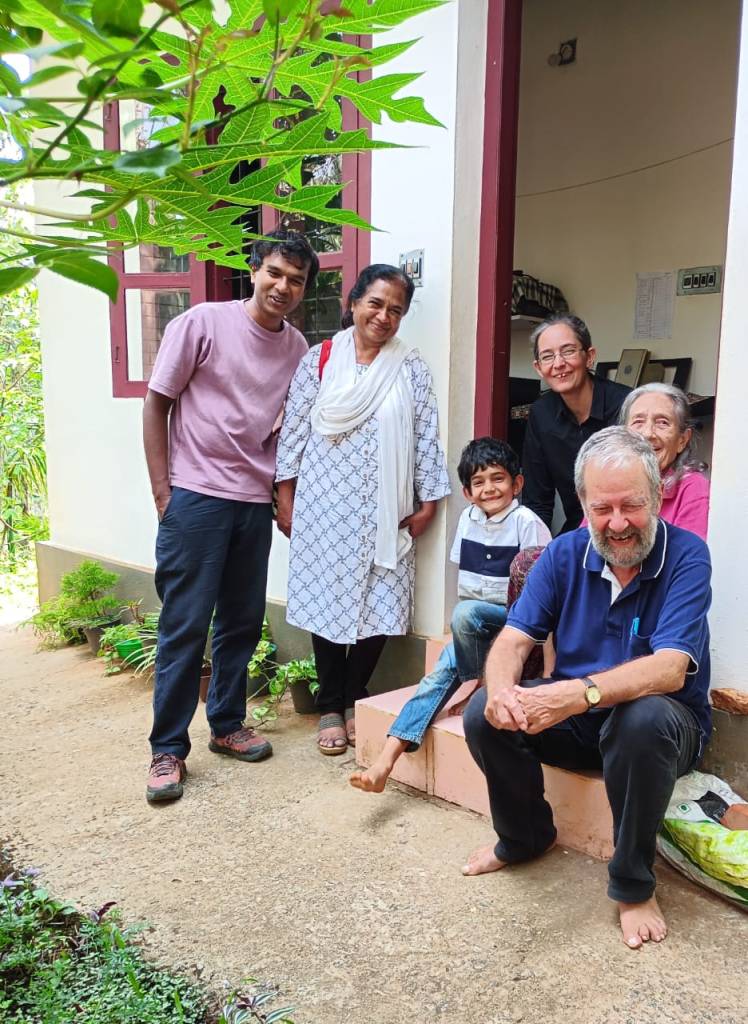
Notes by Tim Yeadell
 A Hundred Contemplations
2 responses to “Over the Sea to Skye”
Thanks for sharing your real-life experiences, Tim. It seems like it was an altogether different era!
May God bless you and your family and provide all that you need.
Oh, and welcome to Wayanad, India!
A hard life indeed but rich with experience.
Wayanad and it’s people are more friendly and reciprocating. Glad the Bible found you and you can walk in His Grace