
Even as a little girl, I loved the spice box in my mother’s kitchen. She kept a simple, neat, clean, and well-stocked kitchen. What I loved most of all was that I could hear her sing and hum as she chopped, ground, pounded, and stirred in the sweltering heat of Chennai. She made it all look so effortless.
The kitchen was an entire wing of the house. There was a small pantry with an Allwyn fridge. No one could open it except my mother and grandmother. It was my grandmother’s orders because she thought we would break the door opening it again and again. If it were now, she would have surely put a CCTV camera in the pantry and store. 😈😜 A neat hand towel was carefully hung on the handle of the fridge. The cold water was in old recycled bottles in that fridge, and that was the main attraction for us children. We would go and drink up all the water after playing long hours outside and keep the empty bottles back in the fridge, annoying the adults no end. That beautiful fridge lasted 40 years without any trouble, and when it was finally “exchanged” for a modern one, my mother stood at the gate waving goodbye as the company drove off with it.
The kitchen was the room after the pantry. It had a beautiful, quaint chimney with a counter that was a wee bit too high, and sky blue and cream laminate cabinets. The flooring was old red oxide. The best part of the kitchen was a heavy red wooden table with a raw Kadappa slab. It housed the vessel of milk, the coffee filter, tea leaves, and sugar. On the shelf below sat the spice box. My mother used the slab to chop, peel, and pound, and I would stand and watch her, fascinated. I think that’s where my love for the kitchen and food began.
The kitchen had a large store which was always dark. We had to switch on a light to see anything inside. The month’s provisions would all come home from Simla Store (no idea why a Chennai store was named Simla Store), and my mother would spend many hours sorting them out. There was no plastic in any of the packaging. The grains were all wrapped in newspaper (now we know that may not be safe either) and wound with a jute rope to stay together. She would carefully pour out all the dals into the painted red tins that sat on the shelf, and the grains into tin drums. The unripe bananas sat in the drum, waiting to ripen.
Beyond the kitchen lay the kolathavaram (as we called it), or the work area. This had the ammi and the attukkal (the traditional grinding stones) set into concrete, with a proper channel for the water to go when you washed the stones after using them. The outlet cleverly led to the flower bed outside. The kolathavaram was also the place where vessels were washed, and grains were cleaned and sunned in murams or bamboo trays.
We took it for granted that Amma cooked all our meals. She made most things from scratch at home, and what she couldn’t make, she made sure was available every season and for every festival on the table without fail. Bringing me back from school, she would stop and buy cholam (butta), or watermelon, or nongu. She had many good friends among the sellers, and I would watch her cackle and haggle with them until she was satisfied. I think it was almost like therapy for her. We would stop by Adyar Bakery, and I would press my nose against all the glass jars that were filled with boiled toffees and peppermint and inhale the smells of fresh bread while Amma bought what she wanted. We would also stop by the coffee powder shop, where she would choose the beans, and the man with the handlebar moustache at the counter would holler to the rear of the shop for the order. We would wait patiently until the beans were roasted and ground and bring home freshly ground hot coffee powder for the week. That aroma is part of my DNA now, I think. 😬😛 Therefore, above anything else, my greatest weakness today is a cup of good coffee.
Then, during the mango season, our beautiful Banganapalli mango tree in the backyard would give us loads of mangoes. My mother would get even busier. She would distribute the mangoes to all friends and relatives. The cuisine in the house would be dominated by mangoes. One whole veranda would be cleared to house the mangoes that she would carefully arrange on hay. It used to be mango mayhem.
Chandra, the vegetable vendor, would come in with her large cane basket full of vegetables. She was a large woman with a resplendent bindi and a personality to match. She would plonk herself on the steps of the kolathavaram and loudly start extolling the virtues of the vegetables in the basket while eating paan and engaging in small talk too. My mother would try not to look interested while peering into the basket, and invariably they would chat a while. Chandra always won. She came every single morning with fresh vegetables to our home for at least 20 years. Later, when we all went away to study, and she got to know I was coming home for vacation, she would bring my favourite vegetables and make my mother buy them. ❤️
My mother would roast all the spices and then hand-pound them to make molagapodi (gun powder). She would soak and grind for idlis and dosas every day. We got lovely crisp vadais every Sunday afternoon and grated mango thokku in summers. All the pastes for the vegetable gravies and chutneys were ground on the ammi (grinding stone). So, as you can see, a large part of my childhood memories is dominated by the flavours of my mother’s kitchen. 😜😜 Thus developed my love for the spice box.
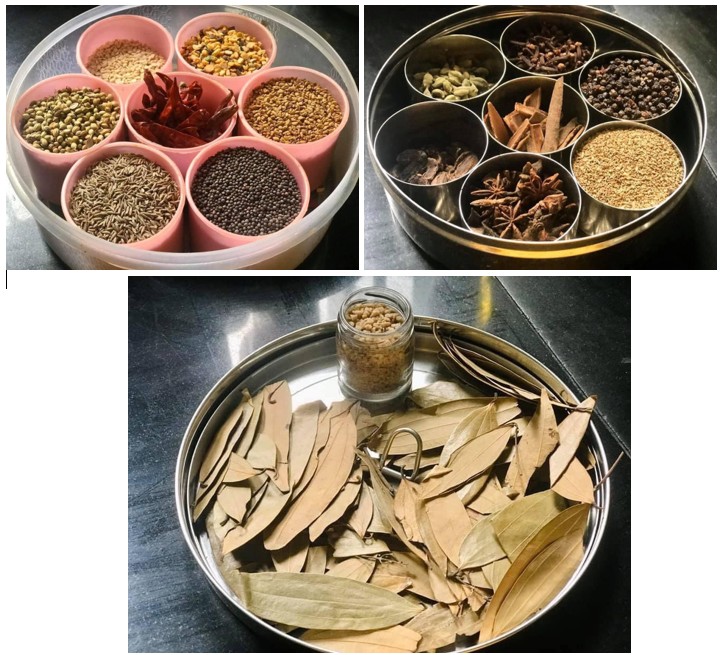
Even on a long, hot day, when I have promised to make the family a much-loved dish and I drag myself into the kitchen, I just have to open these spice boxes for an instant pick-me-up. My nose is assaulted with the smells, as are my eyes with the textures and colours, and all my tiredness simply vanishes. I love to see them like this—neat and organized and filled to the brim. It somehow signals a wholesome kitchen. Whatever we may be cooking, it is these spices that bring it taste and flavour and life. They transform a very mundane vegetable or grain into something so exotic.
Now we also know that they are like a medicine cabinet by themselves in every Indian home. The spice box is what we first turn to as first aid for a home remedy, whether it is a cough, cold, or stomach ache.
Thus, when I opened my spice boxes to cook today, I was enveloped in the fragrance of many memories and emotions, and I was compelled to write about it. They say “variety is the spice of life,” but it is actually the spice that brings the variety to life in the kitchen—and I feel like The Mistress of Spices just standing in front of them. ❤️
Even today, I love my mother’s kitchen. It is not the same kitchen anymore, but her table is still always full of the homemade food I know—and what is most familiar in it is the unmistakable love.
“The secret of happiness is variety, but the secret of variety, like the secret of all spices, is knowing when to use it.”
— Daniel Gilbert

Aparna Rajagopal
 A Hundred Contemplations
One response to “My Mother’s Kitchen”
Hi Aparna, what a lovely account of your mom’s kitchen and glimpses into your childhood!
You’ve captured every single instance so well. I can vividly picture this kitchen in my mind and eagerly await the chance to savor your cooking, enriched by your knowledge of spices. 🙂