
Loneliness is not determined by how many people you know, but by the quality of your connections. It acts as a built-in alarm system prompting us to seek meaningful bonds. By building our lives upon a foundation of God’s presence, raising pillars of identity, community, and purpose, we can break free from isolation and rebuild structural strength.
The Architecture of Connection: Rebuilding Our Lives in a Lonely World

Loneliness is an experience almost everyone shares, yet very few of us feel comfortable talking about openly. We often hide our isolation, unaware that true relief comes from understanding how God designed our relationships.
My own journey with isolation began when my husband, an Air Force doctor, passed away. I suddenly found myself widowed at 36 with small children. One afternoon, my five-year-old son looked at me and asked, “Ma, when I see your face, why are you always crying?”. I was not shedding tears, but my deep grief was visible to everyone.
At that moment, I made a firm decision to build a happy environment for my family. I joined a community club where we spent our evenings swimming and playing badminton. That single practical step kept loneliness from taking over and it became the foundation for rebuilding my life.
An architect always begins a project with a design. In the exact same way, God has meticulously designed our lives to be supported by a framework of healthy relationships—with Him and with one another.
Part 1: Understanding Loneliness
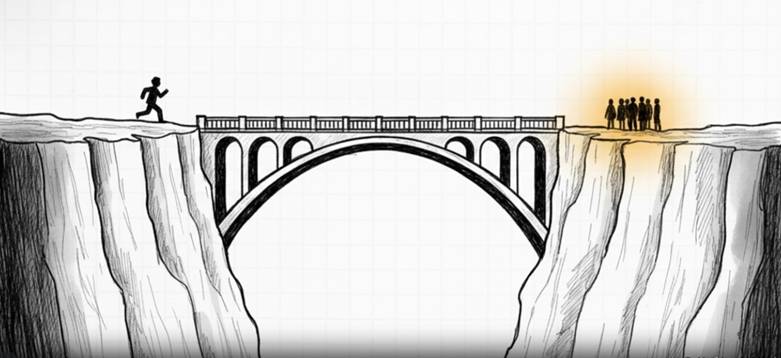
To bridge our social gaps, we must first understand what loneliness actually is. Psychologists Daniel Perlman and Letitia Peplau offer an influential definition:
“Loneliness is the gap between the relationships we desire and the relationships we believe we have.”
Daniel Perlman and Letitia Peplau
This means that loneliness is not a headcount problem.
Consider two distinct scenarios:
The Solitary Hiker: Spends a weekend completely alone in nature and returns refreshed.
The Party Guest: Attends a crowded party with fifty people but goes home feeling entirely invisible.
Loneliness is never measured by a physical crowd; it is measured entirely by perceived connection.
A Signal, Not a Weakness
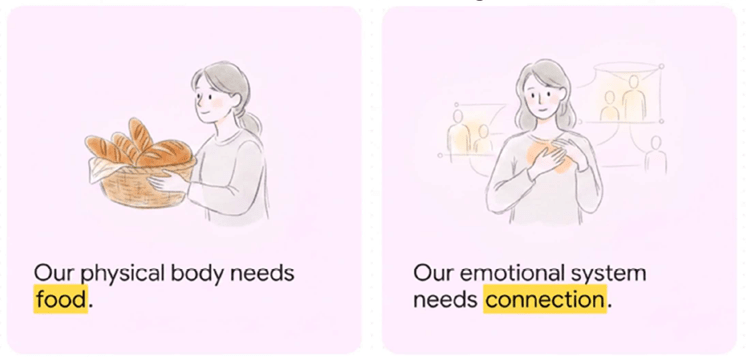
Feeling lonely is not a sign of personal or spiritual failure. Just as hunger is a physical signal that your body needs food, loneliness is an emotional signal that your soul requires deep connection.
Many people attempt to fix this issue by hyper-activating their schedules with more meetings, events, and social media tracking. However, if the underlying quality gap remains unaddressed, the internal loneliness remains untouched.
The 6 Faces of Loneliness
Loneliness is highly complex and manifests in six distinct forms:
- Emotional Loneliness: Feeling empty because you lack a truly intimate, trusted confidant or life partner.
- Social Loneliness: The painful feeling of exclusion or not belonging within a community circle.
- Existential Loneliness: Feeling fundamentally alone in the universe or struggling to find your personal purpose.
- Situational Loneliness: Triggered by sudden changes like moving to a new city, starting a new job, or experiencing a loss.
- Chronic Loneliness: A persistent emotional state that lasts for years, blending social and situational factors.
- Modern or Digital Loneliness: The exhausting feeling of being constantly connected online while lacking face-to-face depth.
The Downward Spiral of Isolation
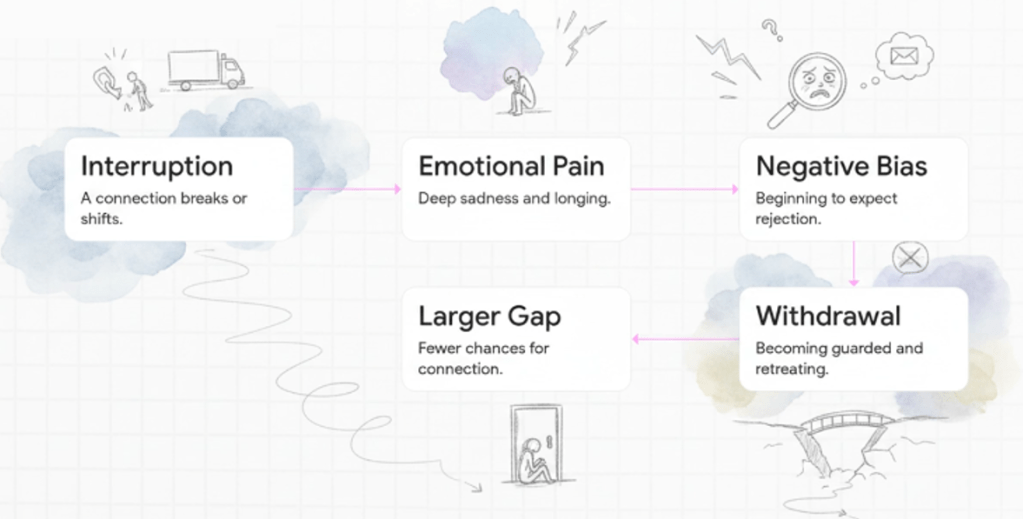
When chronic loneliness is left unaddressed, it follows a highly predictable downward spiral:
- Interruption: A loss, transition, or rejection interrupts your current social connections.
- Emotional Pain: The unmet need for community creates a deep sense of sadness.
- Negative Bias: Your thinking changes, and you begin to constantly expect rejection from others.
- Withdrawal: To protect yourself from pain, you stop initiating conversations and decline social invitations.
- Larger Gap: Defensive withdrawal minimizes your relational opportunities, restarting the cycle.
This is why simple commands like “just go meet people” are ineffective. Breaking this deep cycle requires intentional encouragement, safe relationships, and professional support.
Part 2: Romantic Loneliness
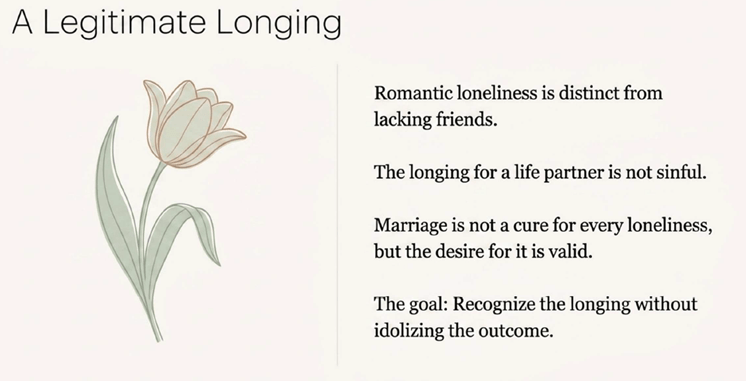
The longing for a life partner is a distinct form of isolation. A person can possess an active career, a loving family, and a busy church community, yet still feel romantic loneliness. This desire is not sinful, and experiencing it does not mean your faith is weak.
The Tension of the Waiting Period
When the desire for marriage continues unfulfilled for years, comparison quietly enters the heart. Social media platforms accelerate this pain by broadcasting constant milestones—engagements, weddings, and baby announcements. Comparison whispers destructive lies:
“I am falling behind,” or
“Something is wrong with me.”.
Consequently, your identity shifts from who you are to what you do not have.
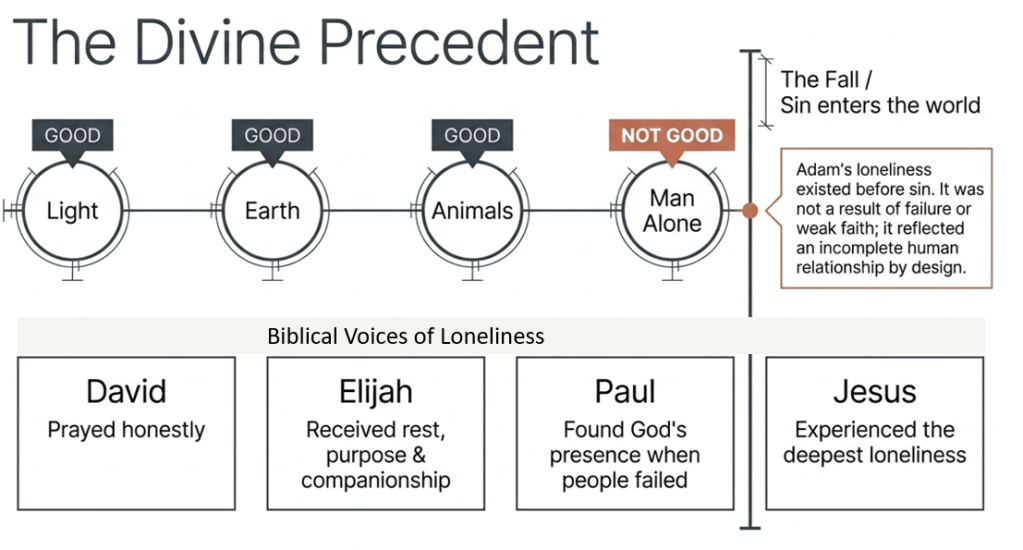
Scripture acknowledges this relational gap right from the beginning of creation. In Genesis, God declared everything He made to be good. Then, for the very first time, God says, “It is not good for the man to be alone.”
Adam was not isolated because he lacked faith or failed; his loneliness reflected an incomplete human relationship by design. God Himself identified this relational gap.
Many spiritual giants in the Bible experienced intense seasons of isolation:
- David prayed honestly out of deep personal isolation.
- Elijah received physical rest and a renewed purpose when he wanted to give up.
- Paul found the presence of God when his human companions failed him.
- Jesus endured ultimate isolation on the cross.
When loneliness whispers that you are unwanted, God’s truth declares:
“I have loved you with an everlasting love” (Jeremiah 31:3).
This reality allows us to stop waiting as empty people and begin waiting as individuals who are already deeply loved.
Part 3: God’s Providential Care
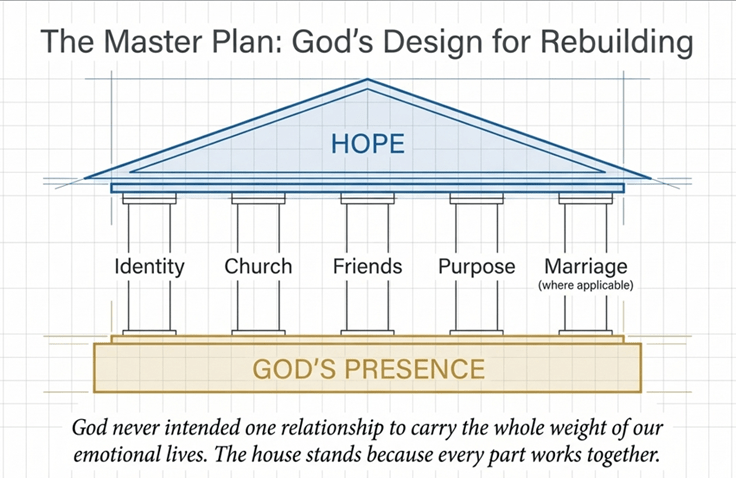
God rarely removes loneliness through an instant miracle; instead, He rebuilds our lives by strengthening a framework of multiple connections. Expecting a single relationship like marriage to carry the full weight of your emotional life places an unstable amount of pressure on it.
God’s structural plan for a healthy life is balanced across specific elements:
- The Foundation (God’s Presence): Anchored on Hebrews 13:5, “I will never leave you nor forsake you.”. God does not promise we will never feel lonely, but He guarantees we are never alone.
- Pillar 1 (Identity in Christ): Building your personal worth on being accepted by God rather than on your relationship status or social popularity.
- Pillar 2 (Church Family): Moving past superficial Sunday greetings. We must shift our mindset from asking, “Do I belong here?” to asking, “Who can I help belong?”.
- Pillar 3 (Friendships): Cultivating deep bonds through intentional conversations, shared experiences, trust, and time.
- Pillar 4 (Purpose): Engaging in a shared mission. Serving others prevents isolation from consuming your identity.
- Pillar 5 (Marriage): A good gift, but one that was never intended to carry the entire weight of your emotional system.
- The Roof (Hope): A protective layer resting on God’s faithfulness that shields us during storms, allowing us to wait without falling into despair.
Bridging the Gap: Practical Actions
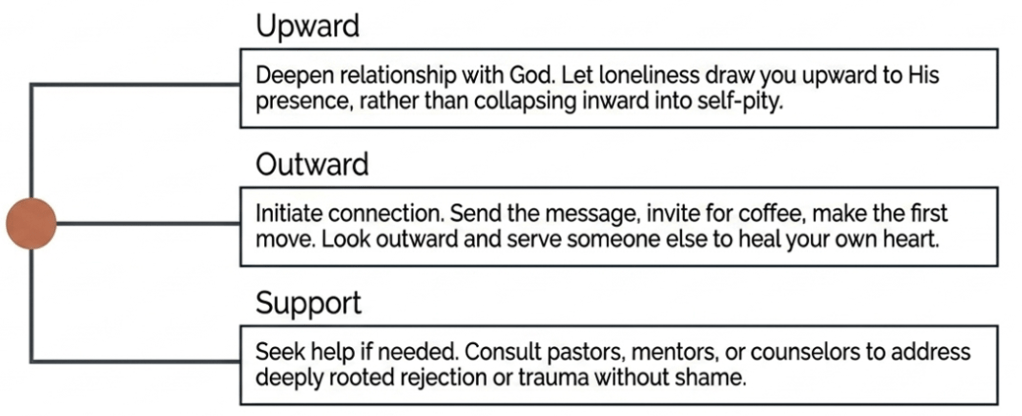
Rebuilding your life after a disruptive loss requires taking regular, ordinary steps:
- Look Upward: Deepen your relationship with God. Let loneliness drive you toward prayer and Scripture rather than collapsing inward into self-pity.
- Look Outward: Take the initiative. Send a text, invite someone for coffee, join a small group, or serve your local community.
- Seek Support: If your isolation is rooted in deep trauma, rejection, or depression, talk to a pastor, mentor, or professional counsellor without shame.
- Invest in Growth: Do not put your life on hold while waiting for relationships. Take a course, learn a language, practice a hobby, exercise, or travel.
As Samuel Ullman beautifully wrote in his poem Youth:
“Nobody grows old merely by a number of years. We grow old by deserting our ideals. Years may wrinkle the skin, but to give up enthusiasm wrinkles the soul.”
Evidence of Rebuilding: Small, Faithful Steps
How God rebuilt my life.
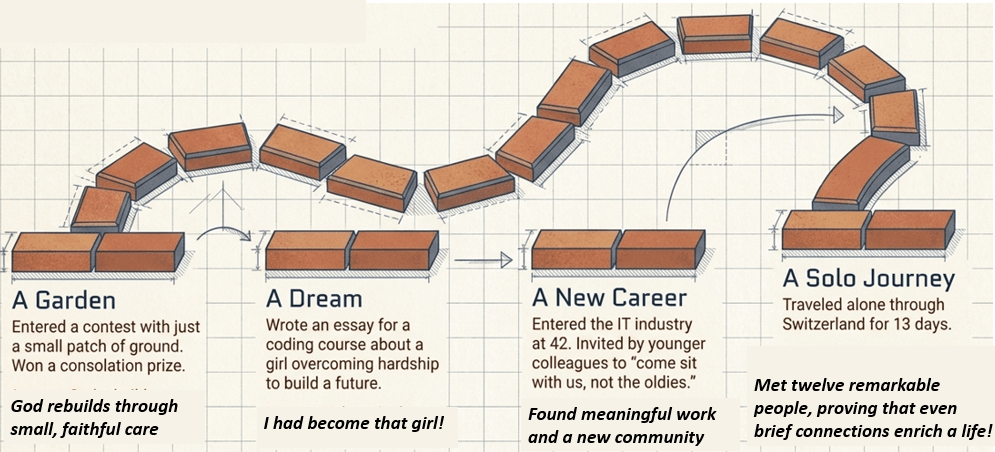
God answers our prayers through practical, everyday opportunities that we often overlook while waiting for a grand miracle. He systematically rebuilt my life through tiny events that played a significant role.
A Garden
Soon after moving into my new house, I entered a “Pretty Garden” contest. The funny thing was, I didn’t really have a garden—just a small patch of ground with a few jasmine shrubs. I worked daily on my tiny 150-square-foot garden. To my surprise, I won a consolation prize, while the first prize went to the owner of a thirteen-acre garden!
God rebuilt my life in much the same way—through small, faithful steps that gradually brought new life.
Nurture the spark of enthusiasm in your life.
A Dream
I took the entrance test for a government-sponsored Basic Programming course. One of the questions was to write an essay based on a picture projected on the screen. The picture showed a young woman working at a computer.
I imagined her life. I wrote about a girl who rose from difficult circumstances, worked hard, kept learning, found meaningful work, and built a better future. Years later, I realised I had written my own story! I had become that girl.
A New Career
My first job in the IT industry came when I was forty-two. I was older than almost everyone else on the team; most of my colleagues were in their twenties or early thirties.
But age never became a barrier. In fact, one day at a conference, I was sitting with the other managers when, during the lunch break, a younger colleague said to me, “Jean, why are you sitting with the oldies? Come join us!”. I grinned to myself. If only he knew that I was older than many of the “oldies” he was talking about!
God wasn’t just giving me a new job. He was giving me a new community.
A Solo Trip
Last year, I travelled alone through Switzerland for thirteen days. The mountains were magnificent, but what I remember most are the twelve remarkable people I met. Looking back, I believe God placed each of them along my journey.

Your Personal Challenge
Friendships usually begin because someone decides to make the first move. This week, do not wait for others to approach you. Instead, look around your immediate environment and ask:
Who can I notice today?
Sometimes, God answers someone else’s prayer for companionship directly through us.
Loneliness is not a final verdict on your worth; it is simply a signal that you need connection.
God is the Master Builder, and He is fully capable of rebuilding your life—one meaningful connection at a time.
Gave the above online talk on Aug 1, 2026 at the APC Singles meet.
 A Hundred Contemplations
4 responses to “Loneliness”
Good write up Jean! You’ve done some research on this subject, and also brought up your personal testimony! All of us can relate to some form of loneliness, and theres always a way to overcome it!
Very interesting Jean, nice graphics too. Good to see your experiences shared which will definitely inspire and motivate. Every step is a footprint towards understanding how to enrich your life.
GOOD one. God is our constant companion, if we can focus on Him, He can make us feel loved and safe.
I really enjoyed reading the article. It was well thought-out, beautifully written, and the illustrations made it even more effective. I especially loved the illustration of the five pillars of our emotional lives — identity in Christ, friends, church, purpose, and marriage. The way this was presented really resonated with me.
To me, the pillar of marriage represents more than just romantic love between partners. It reflects God’s beautiful design for building a family, raising children, and nurturing meaningful connections with our extended family.
Thank you! ❤️